
Private tailor-made journeys of a life time

(+84) 942777545
sales@vietnamescapetours.com
Need Help?
Private tailor-made journeys of a life time
Aug 18, 2023
By Ms. Minh Thu
Located on Phu Tran Phu Hoi An, built in the 16th century, Fujian Pagoda, also known as Fujian Assembly Hall Hoi An, is a long-standing historical relic, a typical architectural work of Hoi An city. This is the place which has preserved the unique and valuable traditional architectural values. Nowadays, Fujian Assembly Hall Hoi An is open to tourists to visit. So if you are planning to pay a visit to this place, the best Vietnam tour operator will help you have some information before you go.
When was the Fujian Assembly Hall Hoi An built?
The Fujian Assembly Hall was established in the 16th century, but its prime period fell in the 17th to 18th century, when Hoi An used to be a lively and important international port of Vietnam. And Fujian Assembly Hall Hoi An was just one of various constructions that Chinese people contributed to the richly cultural land - Hoi An. Fujian Assembly Hall is still a typical architectural construction to Hoianians and Vietnamese people nowadays through many overhauls. This place is even becoming more gorgeous and robust, beautifying the whole landscape of Hoi An.
What are the functions of Fujian Assembly Hall Hoi An?
Fujian Assembly Hall Hoi An has three main functions. This was the communal house of collective activities, where Chinese people from many places gather. The second function was meeting the religious needs of people, where people sacred many gods, including Thien Hau Thanh Mau and the guardian gods to pray for favorable rain and wind, and thirdly this was the place where they worshiped ancestors for their better life. Most notably, Thien Hau Thanh Mau, along with marine gods, is worshiped at the main area of the hall. Thien Hau Thanh Mau is regarded as the most important marine god, protecting fishing men from storms and accidents. On the right side of her is Thien Ly Nhan, the god who can see through the distance of thousands of miles, and Thuan Phong God , who has incredible hearing ability, sits on the left-handed side. Three gods always observe and follow normal people and support them.
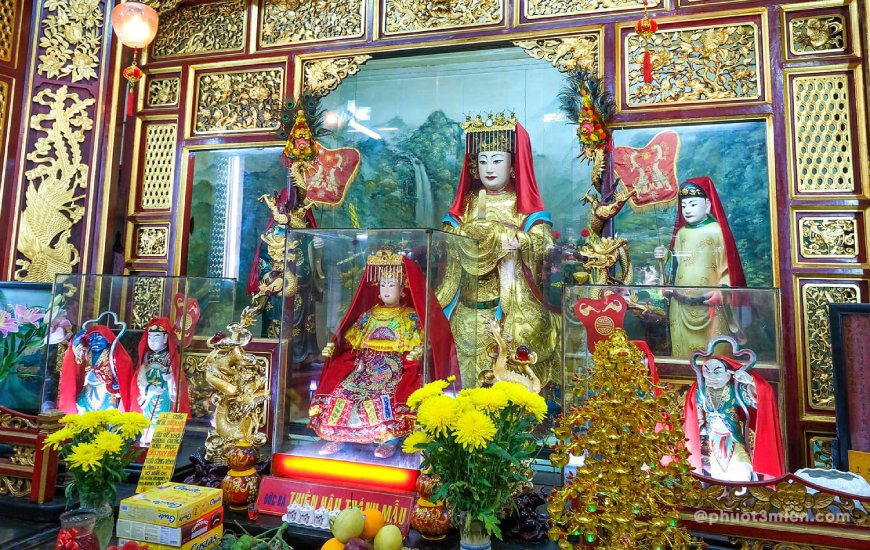
The architecture
Of all the assembly halls in Hoi An, Fujian Assembly Hall Hoi Anis the most spacious and beautiful. This construction is highly appreciated regarding architecture, because it brought traditional architectural values such as “Tam Quan Gate” (A large main gate which includes 3 smaller gates), roof tiles of yin and yang law, boat shaped arch roof, wood framework, and many meticulously carved and decorated. The top is wonderfully adorned with winding dragons, a symbol of authority and solemnity in Chinese culture. Entering inside you will see a broad and open yard with many statues with sophisticated carvings and unique ancient architectural style. Going to the main area, where marine gods are worshiped, you can see the sacred space here. Here you encounter huge red incense rings, sending off the fragrance of serenity.
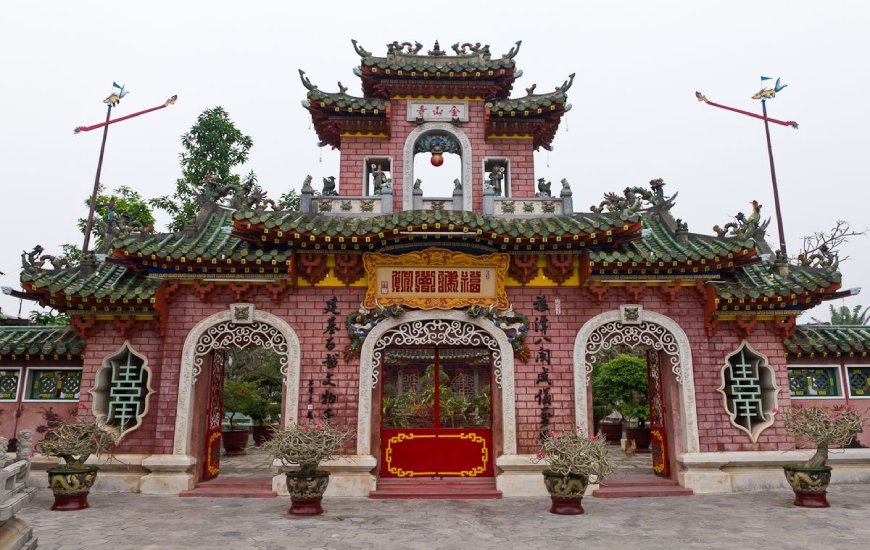
Admire the gorgeous architecture of Fujian Assembly Hall Hoi An
That Hoi An is famous for unique traditional architecture is one thing that everyone knows. Fujian Assembly Hall is an indispensable place in your Hoi An tour if you want to merge into the vintage space with long-standing constructions. If you are a person who fancy architecture, especially traditional ones, Fujian Assembly Hall Hoi An is highly recommended. Traditional beauty is reflected on the yin and yang tiles roof, robust god statues or red fragrant incense rings. To truly take in the scene, visitors should go slowly from the entrance to the courtyard, lake, bonsai, two rows of east-west homes, main hall, backyard, and back hall.

Joining religious activities at Fujian Assembly Hall Hoi An
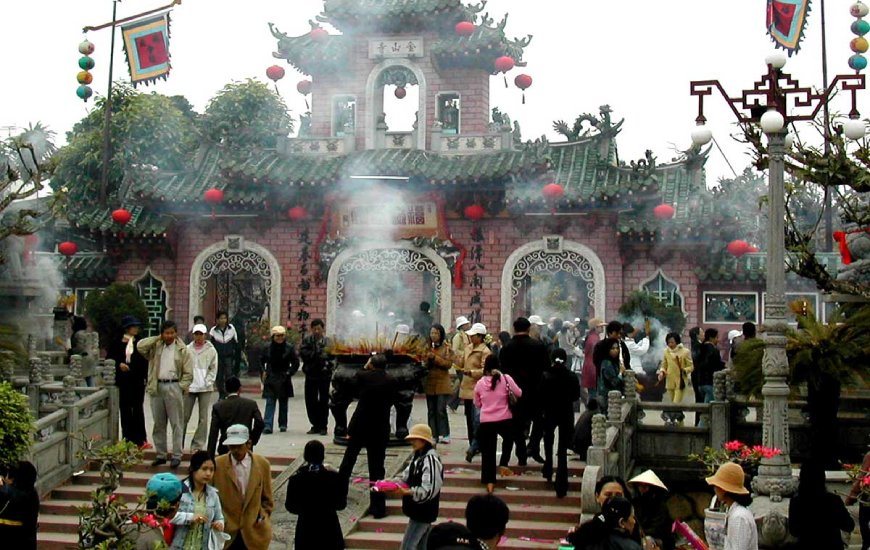
Fujian Assembly Hall is also regarded as a sacred pagoda. Visitors to this site frequently light big incense rings as a way of sending good wishes for health and fortune to their families and loved ones. Vietnamese people often write on a piece of paper with information about their family and hometown in the hope that everything in life will always go smoothly. After the incense burns all the people in the assembly hall will burn these pieces of paper and with such a concept, the wish to the night market is sacred. The Vietnamese also believe that if a family is infertile, they can also pray here so that their wish to have a child will be inspired.
If you are in Da Nang city, you can take into account these two ways to get to Fujian Assembly Hall Hoi An:
Going by motorbike
For approximately roughly 120,000 to 150,000 VND/day, you can rent a motorcycle in Da Nang to travel to Hoi Vietnamese and then see the Fujian Assembly Hall Hoi An. A Vietnamese hour is spent driving. You can see from the map that you should run along the roads that follow Vo Nguyen Giap and Lac Long Quan's beaches from My Khe beach to Cua Dai beach. The Fujian Assembly Hall Hoi An is then reached by turning right onto Hai Ba Trung Street, continuing on to Le Loi Street, turning left onto Phan Chau Trinh, turning right once more, and eventually coming to a stop at 46 Tran Phu.
Going by car
If you are traveling with numerous friends or family members, hiring a private driver will be your best alternative. The price may be higher but you can remove any worry of bad weather or risks when you drive yourself.
The uniqueness of this dish is the variety in the way of preparation, regardless of the season. Any product such as shrimp, pork, chicken, snakehead fish, frog ... can also be processed into noodles, containing all the characteristics of Quang cuisine, with a variety of ingredients and special characteristics. It is a dish originating from rural life, so it has the sincerity and rich flavor like the character of the Quang people. Quang noodle bowl is a colorful work of art, yellow, white, brown of noodles, green of vegetables, chili, pink, red of shrimp, crab, meat...

2. Cao Lau
Cao Lau - a dish with a strange name, but in fact it is a famous noodle dish of the people of Quang. “Cao Lau” – means delicious and tasty food eaten upstairs. Although it is simply noodles, it is considered a specialty of this land. The noodles used in Cao Lau are large, yellow noodles. The yellow noodles are due to being mixed with ashes of Melaleuca firewood - a local tree. The filling includes shrimp, pork, deep-fried dry pork skin, and raw vegetables. The most special feature of this dish is that although it is not really a mixed dish, but a water dish, the broth is very small, not filling the bowl like other types of noodles.

3. Banh Canh
From the ingredients to make the cake to the way to make the broth, everything is very special. Banh Canh fiber is like filter cake and fish cake is made from many different types of fish. Sailfish, barracuda or goldfish, mackerel... all contribute to the great attraction of the famous shallot soup. Although this is a simple dish in Hoi An, the way it is made requires meticulousness and "level" of seasoning for the cook. Because of that speciality, it gives diners a "journey to experience" great flavors.

4. Banh beo
Banh beo, a specialty dish of Hoi An, is always popular in the late afternoon. The smooth rice flour water is poured into little plates, which are then placed in the steamer. The filling is made from shrimp, chopped meat, marinated with spices to taste, then stir-fried, adding a little rice flour water to create a consistency and viscosity for the meat filling. A cup of Banh Beo is only 2,000 VND.

5. Sweet soup
Hoi An is unquestionably a "paradise of sweet soup". Those who adore sweets would undoubtedly "get lost" among the countless delicious types, including black sesame (chi ma phu), lotus seed, maize sweet soup,...You can have a cup of hot, sweet soup for as little as 5,000 VND.

The covered bridge is quite unique, in the middle is a rainbow-style passage, on both sides there is a narrow corridor to make a vacation place with seven wooden compartments. Rather, the entire pagoda and bridge are made of wood, painted and carved with many delicate motifs in Vietnamese architecture - typically dragons, and at the same time, a little Japanese style.

2. My Son Holyland
After many years of ups and downs and changes of history, today My Son Sanctuary is still a relic with unique cultural, artistic and architectural values of humanity, it is the crystallization of wisdom and talent. flowers of many generations. After going through all the sightseeing areas here as well as being introduced to My Son holy land, visitors will experience the culture of the ancient Champa people through art shows such as blowing the trumpet, dance. The flexible and attractive Siva dances will leave an unforgettable impression.

3. Bay Mau Coconut forest
Coming to Hoi An, in addition to the familiar destinations that have become the symbol of Hoi town, try once to visit Van Thanh village, Cam Lang commune to experience the experience of riding a basket boat to explore the unique Bay Mau nipa coconut forest. and new here. Experiencing this activity, you can admire the craftspeople balancing, swinging baskets and other performing skills so that the water splashes must create a beautiful vortex.

From the outside, Tan Ky house is like many old houses in Hoi An ancient town. But the difference compared to hundreds of other old houses is the distillation of the quintessence of Chinese - Japanese - Vietnamese architectures. Coming here, you will admire each line carved with motifs, patterns, and structures on the house that carry the meanings and messages of Eastern philosophy, by talented craftsmen of Kim Bong carpentry village. Hoi An built.

Hoi An Lantern Festival is a highlight of all activities in Hoi An. When you come here, you will have a chance to admire the gorgeously colorful space of thousands of lanterns in various colors and shapes. This vivid picture is even intensified by the lights of houses nearby and the reflection of the water surface in Thu Bon river. You may think you are in a fairy tale in the real world.
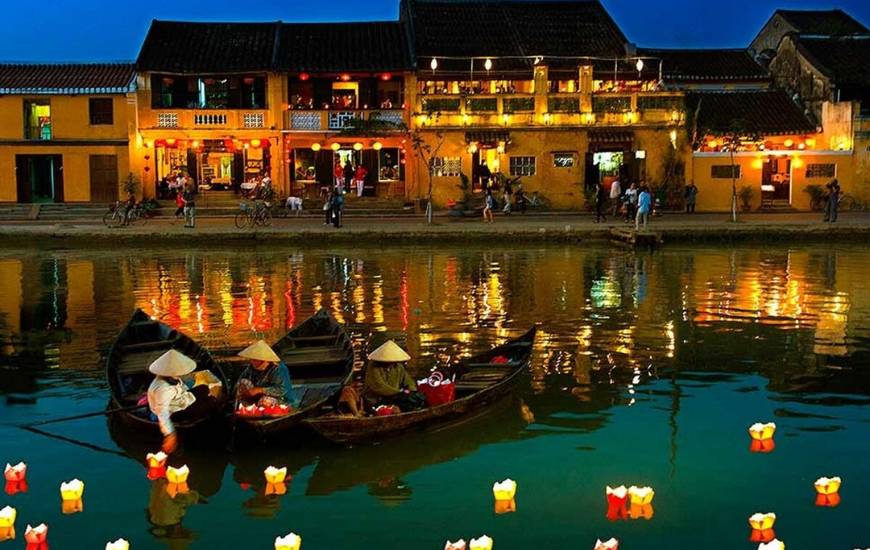
Fujian Assembly Hall Hoi An welcomes tourists all year round. But it is best that you visit Hoi An in the dry season, which lasts from February to August, to have the complete experience in beautiful architectural constructions in Hoi An. However, exploring Hoi An in the rainy season is also interesting. The topography of Hoi An ancient town is a low-lying area, every time the heavy rain season lasts, almost the whole neighborhood will be flooded with rainwater and flood water from upstream of the Thu Bon River. This is also the time to attract a large number of tourists to the "floating season" in Hoi An, when they can experience sailing boats along this unique place.
When you visit Fujian Assembly Hall Hoi An’, remember to choose a suitable dress code. Because this is a sacred place, you should wear formal and long clothes.
Fujian Assembly Hall Hoi An is especially crowded during Tet holiday, full moon day and first day of the month, so you should protect your belongings carefully.
Avoid making too loud noises when others are burning incense.
Through many times of restorations and repairs, this place has become more spacious and splendid and contributes to beautifying the appearance of Hoi An's ancient urban architecture. Still, Fujian Assembly Hall Hoi An is still a typical architectural construction to Hoianians and Vietnamese people nowadays through many overhauls. This place is even becoming more gorgeous and robust, beautifying the whole landscape of Hoi An. So if you have a chance to get to Hoi An, don’t ignore this beautiful place!


