
Private tailor-made journeys of a life time

(+84) 942777545
sales@vietnamescapetours.com
Need Help?
Private tailor-made journeys of a life time
Aug 2, 2023
By Ms. Anh Thu
Overview
Paying a visit to Hoi An, you cannot miss Quan Cong Temple Hoi An-one of the most sacred temples in Hoi An. There are so many justifications for why this temple gained a tremendous reputation, including its historical and cultural significance or Eastern architecture. Being a prominent temple in Hoi An, it is worth visiting, so let’s learn more information about Quan Cong Temple with us!
Quan Cong Temple, also known as Ong Pagoda (Quan Công Miếu or Chùa Ông in Vietnamese), was founded by a Chinese immigrant in 1653. The temple is a center of worship for Quan Cong ( - Guan Yu), also known as Quan Van Truong (Quan Vu) in Vietnamese, a renowned Chinese military leader.
Ong Pagoda which is recognized as World Heritage Site by UNESCO, is well-known for its spiritual attractions as a historical relic. For visitors looking for architectural and cultural delights in Hoi An, Quan Cong Temple stands out as one of the most well-known holy places with a rich history.
One of the most well-known tourist destinations in the city is the Quan Cong Temple, which is located in the heart of Hoi An Ancient Town. You can find Quan Cong Temple at the address: 24 Tran Phu Street, the center of Hoi An ancient town, in Quang Nam province.
In 1653, Quan Cong Temple (Quan Thanh Mieu), a temple dedicated to Quan Van Truong, was built. He was a well-known leader with talent, a powerful will, bravery, righteousness, and other virtues. Quan Van Truong is the symbol of loyalty - sincerity - integrity - justice. He lived during the "Three Warring Kingdoms" conflict under the Han Dynasty's authority in China.
This is also an example of the standard work done by Chinese artisans working with natives from Vietnam to hand-craft intricate statues and decorations in a vibrant temple. The temple is brilliantly colored in red, yellow, and green, and the ornamental themes are still beautiful today.
Quan Cong Temple, like many other old buildings in Hoi An, has undergone several restorations, although the majority of its original architectural characteristics have been intact. As a part of the national historic and cultural heritage, the temple has been acknowledged.
Quan Cong Temple is the most unique work in Hoi An because of its essence of traditional Confucian architecture.
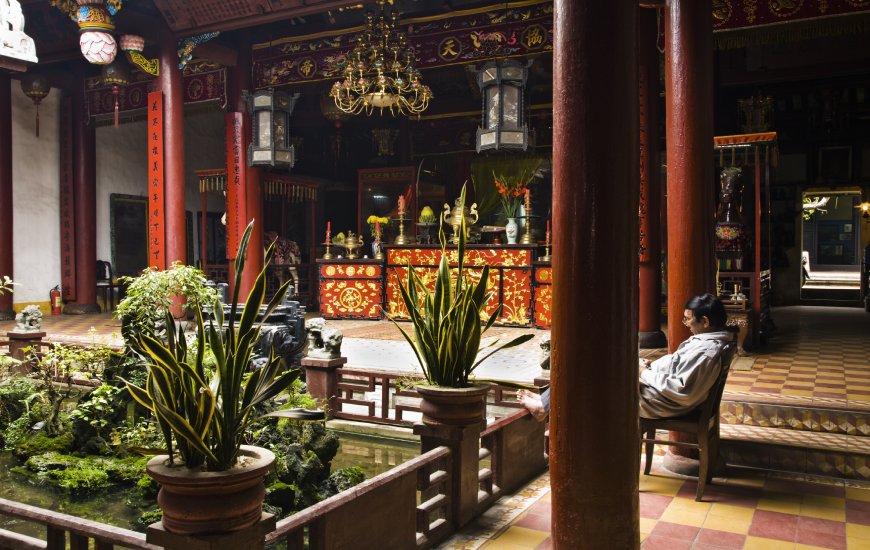
Ong Pagoda, which is imprinted with ancient Chinese architecture, was constructed with a truss construction in the shape of the Chinese word "国 Guó" which means "Country." The front hall, the right and left rows of the house, and the main shrine in the center form the Chinese word 国.

Different from the fish-scale tile that reflects the characteristics of water, often used by the ancient Vietnamese, tubed enamel tiles are colored glazed tube tiles, a form of tile that has historically been utilized by the Chinese to cover the temple's rooftops. The top borders are curved and embellished with dragons and unicorns (two main holy animals in Eastern culture) working together to create an overall gorgeous but old temple.
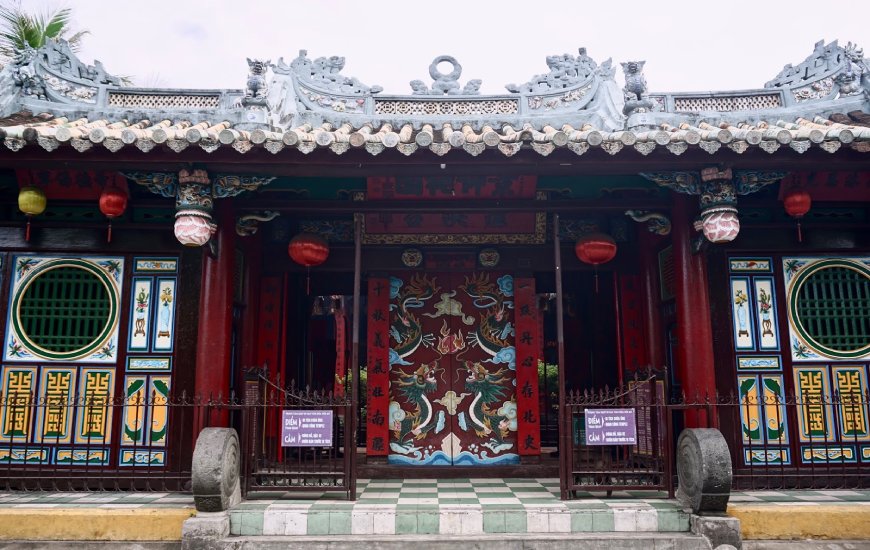
The vivid hand-painted calligraphy of blue clouds and a green dragon on the front door represents Guan Yu's figure. Two dragons that are concealed in blue clouds are etched into the entrance door. Chinese legend holds that Quan Cong represents a white tiger and a green dragon.
At the Quan Cong Temple, the Skydoor
The Sanctuary of Quan Cong Temple receives natural light, fresh air, and a holy environment through the sky portal in the center of the temple complex.
The most holy atmosphere is provided by the major shrine. An exquisite, three-meter-tall figure of Quan Cong, with a serious expression and somber eyes, is displayed on the main altar. The statue is dressed with dragon embroidery. There are two sculptures of Quan Cong's administrative Mandarin, Quan Binh (Guan Ping), and his devoted bodyguard, General Chau Xuong (Guan Xing), on either side of him. White Horse and Red Hare, two horses that General Quan Cong rode during his bloody battles, are honored on either side of the shrine.
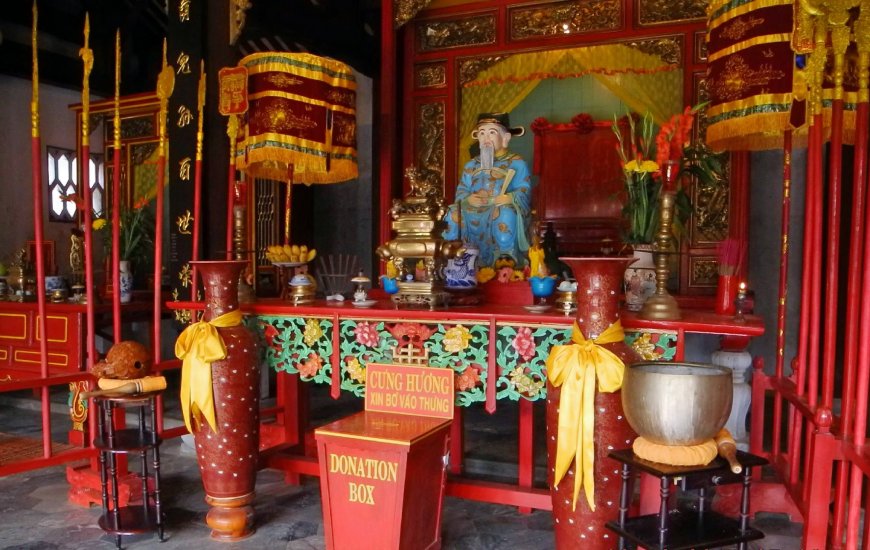
On the central altar, which is located at the rear of the sanctuary inside the temple's main edifice, is a statue of Quan Cong. Paper mâché was used to create the statue, which was then mounted on a wooden frame. It is usual to see individuals present an offering to this statue, and each time it does, the keeper knocks a bronze bowl nearby to produce a bell-like sound.
Quan Cong Temple has a committed design and is home to many priceless historical artifacts, including honored ordinations, 30 horizontal lacquered boards inscribed with Han characters, a fable by Nguyen Nghiem (the father of well-known Vietnamese poet Nguyen Du), and two paintings by Uong Si Cu and Nguyen Lenh Tan.
As soon as you enter the Temple, you are walking through a door to go back to the past. The Temple reflects an ancient atmosphere when you enter Quan Cong Temple in Hoi An through the main door, you will immediately sense the reverent atmosphere created by the somber altar with fragrant incense, worshiping weapons, bronze gongs, drums, and other tributes from the Bao Dai Emperor-Nguyen dynasty.
As one of the most revered temples in Hoi An, Quan Cong Temple is routinely visited by residents and businesspeople who come to worship the general and give sacrifices. Additionally, visitors can pray to gods for favors and luck while burning incense. Residents often come here on important occasions to offer sincere offerings and pray for peace and happiness.
Quan Cong Temple is a wonderful location for you if you're looking for unusual locations to capture seductive pictures. Its unique design, which combines old and bright elements, is undoubtedly noteworthy to be photographed. We make sure that you will have amazingly one-of-a-kind photos with your friends or family.
Admiring Quan Cong Temple yields a giant insight into Eastern culture and Architecture. In addition, intriguing folklore and historical facts about the temple's surroundings will enlighten guests about the way of life and religious practices of the region.
Hoi An, an ancient town in Minh An ward, is surrounded by narrow roads and a 2 km2 area. Popular attractions include the Japanese Covered Bridge (Chua Cau) and Tran Phu Street, where visitors can find Quan Cong Temple at 24 Tran Phu Street.
Visitors can reach Cua Dai Street, Tran Hung Dao Street, and then a left into Nguyen Hue Street. The temple is on the left after around 240 meters of further walking. Visitors can opt to walk on foot or hire a bicycle to roam about and take in Hoi An's beauty along the route since the distance is just approximately 1 kilometer.
You must purchase a ticket to enter Hoi An old town to view all the historical sites. The Hoi An Entrance ticket comes with 5 pieces, allowing you to enter 5 different attractions at random. They will cut one of the five pieces on your admittance ticket as you visit each location. Each individual must pay an entrance charge of 120,000 VND (about $6). Children (under six years old) can enter for free.
Tet Holiday Festival: On the Lunar New Year, many people visit Quan Cong Temple to worship and make various good luck, peace, and health-related wishes. They will make wishes for Quan Cong on Xuan Lien paper, which will be hung on sizable incense rings. Every year, the Quan Cong Birthday Festival is held on the sixteenth day of the first lunar month.
When entering the temple, dress appropriately, discreetly, and in line with excellent customs and traditions.
To prevent damaging priceless treasures in the temple, avoid randomly touching them.
When entering the temple, refrain from creating noise or laughing and rushing.
Keep your items safe while participating in temple rites.
When snapping pictures, put your flashlight out of the way.
For your trip to Hoi An, we highly recommend you visit Quan Cong Temple Hoi An, which is the most holy temple in the region. Through this post, Vietnam Escape Tours hopes you can learn some things about this unique-architectural temple in Vietnam. Thank you so much so reading.


