Private tailor-made journeys of a life time

(+84) 942777545
sales@vietnamescapetours.com
Need Help?
Private tailor-made journeys of a life time
Feb 21, 2023
By Mia
Duong Lam Old Village, which has distinctive architecture and preserves the fundamental characteristics of ancient Vietnamese villages, has welcomed countless tourists from all over the world. Visitors will get the chance to learn about the history of Vietnamese culture and customs during a day trip from Hanoi to Duong Lam, as well as to take in the distinctive architecture of the region's remaining traditional homes constructed of laterite brick.
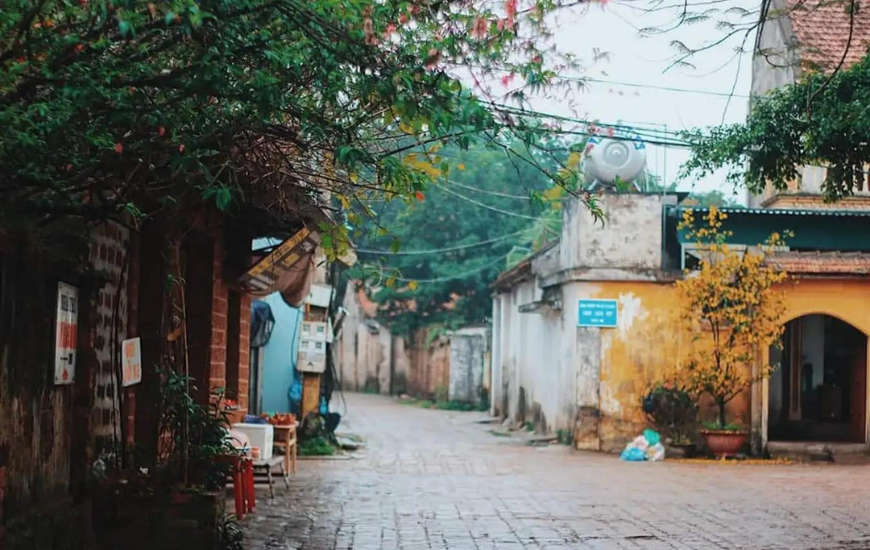
Duong Lam Ancient Village is located in Son Tay Town, about 50 kilometers from the center of Hanoi. The entire town, with its historic homes dating back more than 400 years, is regarded as a one-of-a-kind laterite museum. On May 19 2006, the settlement was designated as a National Historical & Cultural Monument. It is the first historical village in Vietnam to be designated as a top-tier architectural aesthetic site.
You may go to Duong Lam Ancient village on bus lines 71, 70, and 77, which leave from My Dinh station, Kim Ma station, and Ha Dong station, respectively. All bus lines stop at Son Tay station, where you may grab a cab or a motorcycle to get where you're going. Yet to explore each historical place, you must go throughout the wide area. If going about on foot takes too much time and effort, renting a bicycle is an alternative. They may rent by the hour or the day depending on your choice.
You may drive by private vehicle or motorcycle to Son Tay province, which is close to Hanoi if you want to have a more memorable experience. You can proceed in one of two ways. Following Thang Long Avenue and turning right at Hoa Lac crossroads is the first option. After that, take Road 21 through Son Loc to its intersection with Road 32 and go as indicated by the signpost to reach Duong Lam hamlet. The alternate option is to travel to Son Tay town along Highway 32. To get to the village gate, follow Road 21 and look for the crossroads on the left-hand side.
A private tour in Vietnam with a private car and private guide will be comfortable for your group.
In addition to the aforementioned three options, you can select Hanoi tour packages considering Duong Lam Ancient Village is a well-known tourist destination in Hanoi. Tourism organizations like Best Vietnam tour Packages provide package tours and offer advice on the best travel path to see villages and other Hanoi sights. This is the most practical and secure option for international tourists who want to travel.
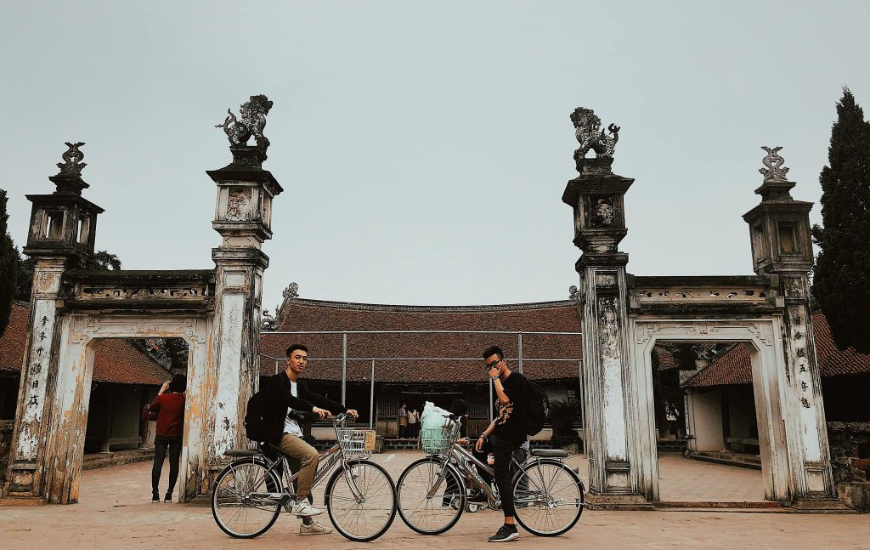
The Tay Phuong Pagoda, the Ngo Quyen Mausoleum, which celebrates a national hero who battled against the Mongolian troops in 938, and the Mia Pagoda, which was constructed in the 15th century and includes 287 figures of all sizes, are all recommended to tourists. Cycling is an option for tourists to get around these attractions. Throughout the village, there are many places to hire bicycles.
Several little wooden drink kiosks may be found as you stroll through the Duong Lam ancient village, appearing to be in a very tranquil setting. Tourists can take a break in a little wayside booth if they are hungry and have been traveling for a while. In this area, it's simple to find "Che lam" sweets and lid eugenia tea. There are two types of lam tea available here: lam Gac tea and standard lam tea. Each kind is delectable and has a distinctive flavor of its own, therefore visitors are required to bring a present of this special flavor.
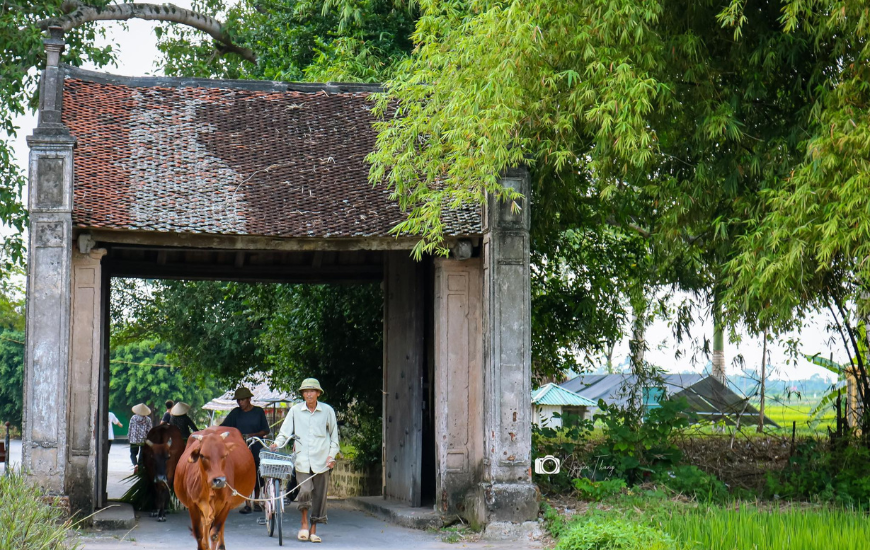
The entire area of the Duong Lam ancient village is 800.25ha. The nine little villages that make up the complex of the ancient hamlet in Son Tay are Mong Phu, Dong Sang, Doai Giap, Cam Thinh, Cam Lam, Phu Khang, Ha Tan, Hung Thinh, and Van Mieu. The hamlet today has 956 ancient dwellings, many of which are older than 1649, 1703, 1850, etc. Each of these old houses had five or seven rooms, and they were all built using traditional components including laterite, wood, bamboo, terracotta brick, and tile.
Mrs. Dien's old house has been here for around 200 years. Within the home, Mrs. Dien's granddaughter will welcome guests who wish to learn about this house with traditional "Che Lam" candy and lid eugenia tea. In keeping with traditional Northern design, the home is divided into three sections, with an altar positioned in the middle and facing the entryway. The yard also features a flower garden and some antique wine jars.
Mr. Hung’s old house is the oldest residence in Mong Phu. Twelve generations have resided in this home since its construction in 1649, for over 400 years. As soon as you reach the gate, you will be able to observe an old gate that was held together with adhesive by rock, earth, and mud. The home is divided into five sections: the bedrooms are located in the remaining two sections, while the three central sections are used for ancestor worship. A traditional garden in the yard filled with flowers and wine jars creates a serene charm. Nowadays, the historic house of Mr. Hung has been retained nearly entirely intact, preserving the spirit of Vietnamese architecture.
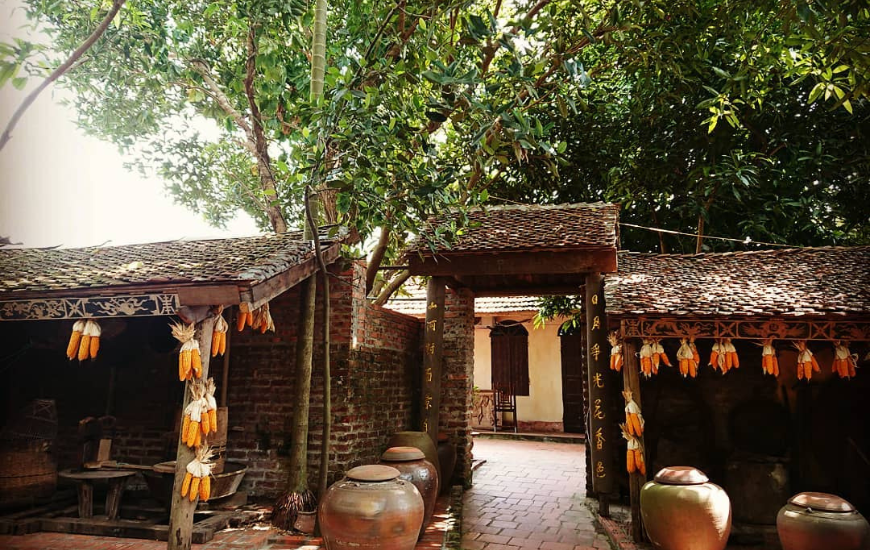
Mr. The's old house, which is situated in Xui hamlet, Mong Phu village, contains seven compartments that were constructed using mortises rather than nails by custom. This family, which has been together for 14 generations, is well known for their sauce-making. The aroma of rice sauce was quite strong as soon as you entered the yard, and there were several jars of it arranged closely together. Like many other residences in the highlands of northern Vietnam, this one features a corn grinder with a large amount of maize hanging on the horizontal bar.
For tourists visiting Duong Lam Ancient Village, Mia Pagoda is a must-see sight on their Vietnam tours that they should not skip. One of the ten oldest temples in Vietnam, it was allegedly constructed at least in the fifteenth century. Although it was abandoned in the 17th century, the original pagoda was restored in 1632 by the widow of northern Vietnamese chieftain Tring Trang. She was known as Lady Queen Mia by the locals, and Mia Pagoda served as the source of the pagoda's name.
Mia Pagoda is home to 287 sculptures, both big and little, including 174 painted-gold terracotta figurines, 106 wooden statues, and six bronze statues. Several of these sculptures are recognized as high art in Vietnam, such as a series of eight terracotta statues of Bat Bo Kim Cuong, each of which depicts a general getting ready to combat to uphold Buddhism and vanquish evil. The skill and inventiveness of the ancient creators are evident in the delicateness of these statues, which exhibit excellent aesthetic expression.
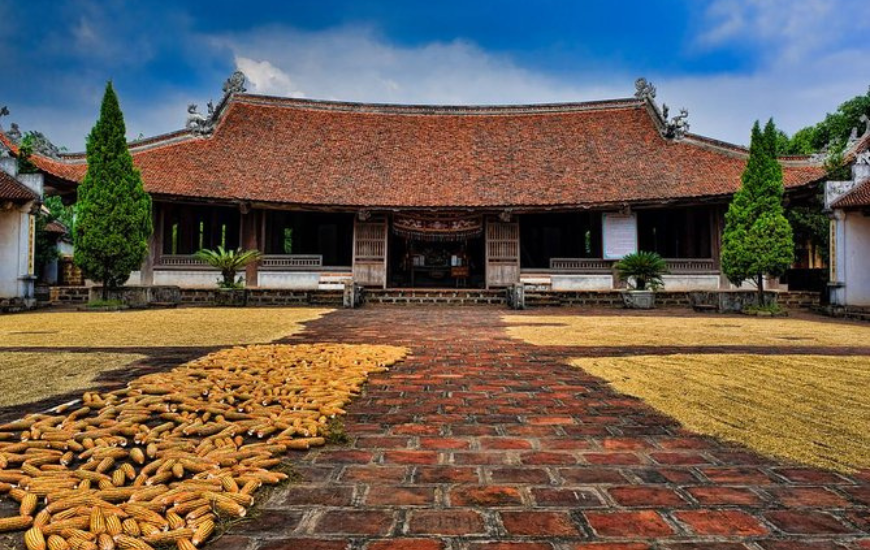
Duong Lam Ancient Village is known as "The Land of Two Kings" due to the births of two Vietnamese Monarchs, Phung Hung (761–802) and Ngo Quyen (896–944). As their countries gained independence, both men conducted resistance campaigns against northern invasions and were proclaimed kings.
Although there are several Phung Hung temples in Vietnam, the one in Duong Lam hamlet has the highest historical and cultural significance, the biggest scale, and the most distinctive architecture. Phung Hung temple, however, bears the architecture of the Nguyen Dynasty in the early twentieth century as a result of a significant repair that took place in 1889, under the reign of King Thanh Thai, giving the temple its current look.
Ngo Quyen's temple and tomb were built on Cam Hill, a towering hill that faced east. The temple was built higher, around 100 meters from the cemetery. The mausoleum of King Ngo Quyen was renovated in the second Minh Mang year after it was constructed in the 27th Tu Duc year. The tomb is built like a tombstone dwelling and is around 1.5 meters tall. A throne sits in the center of the tomb, and the words "Tien Ngo Vuong Lang", which means Tomb of King Ngo Quyen, are written in four Chinese characters on the headstone.