
Private tailor-made journeys of a life time

(+84) 942777545
sales@vietnamescapetours.com
Need Help?
Private tailor-made journeys of a life time
Sep 22, 2023
By Ms. Anh Thu
Overview
How to catch the bus in Hanoi? Public transportation is a cost-effective and efficient system that transports people between areas, primarily funded and operated by local government authorities. It includes buses, underground rail systems, trains, ferries, and cable cars. Hanoi is home to a public transport system, including buses which are prevalent among the locals. For tourists who are not familiar with catching a bus in Vietnam, this post will show you how to catch the bus in Hanoi Vietnam.

Transerco Bus
Hanoi's public transport system, including buses, is operated by state-owned Transerco and private companies. The buses are easily identifiable with their red and yellow colors, but some routes also have green, blue, and orange paint. The earliest bus leaves at 4:30 a.m., while the latest leaves at 10:30 p.m. Service may be extended to 11:30 p.m. on weekends on some routes. Most Hanoi buses are equipped with an audio system to announce the next stop, and LED panels display live arrival information at stops. The network includes subsidized, non-subsidized, airport, and provincial buses connecting Hanoi with neighboring provinces.

VinBus
Besides, VinBus is the first smart electric bus in Vietnam. Currently, VinBus electric bus tickets range from 7,000 - 9,000 VND/trip, in some cases it will be free. The bus is currently operating in two major cities, Hanoi and Ho Chi Minh, with hours from 5:00 a.m. to 10:30 p.m. daily. VinBus was launched with the goal of civilized, modern public transportation, reducing environmental pollution, and bringing fresh air. Not only does it impress with its professional service, but VinBus is also a smart bus that uses 100% electric motors, does not emit CO2, and does not make noise during travel.
When traveling in Hanoi Vietnam, you can consider public buses which can be beneficial. First and foremost, buses are a cost-effective mode of transportation. The bus fare usually varies from VND 7,000 to VND 40,000 depending on the type of bus and distance needed to travel, but usually, the bus fare is 7,000 VND for a bus route. The Hanoi bus network, with over 1,000 buses and 100 routes, offers a dense and convenient public transport option. Walking one or two kilometers daily and changing bus routes can be beneficial for health, but some sidewalks are not designed for pedestrians. Other advantages can be mentioned, such as weather-free travel, access to the internet, and entertainment options like podcasts and audiobooks. Traveling on buses is safer, as it doesn't involve personal injury or accidents, and it allows for more relaxed arrivals without the stress of driving. On top of that, traveling by bus is eco-friendly like other public transportation since it contributes to reducing air pollution and reducing the amount of greenhouse gas emissions from daily commutes. Road congestion is also improved due to fewer vehicles on the road.

Hop-on Hop-off Bus
An exciting thing for tourists when they come to the Capital of Vietnam is the presence of a Hop-on Hop-off bus. The Hop-on Hop-off bus is a double-decker, top-open bus designed for travelers. It has 13 stops and takes travelers through over 20 famous attractions in Hanoi a Hanoi City Tour, including Dong Kinh Nghia Thuc Square, Hoan Kiem Lake, St. Joseph's Cathedral, Flag Tower, Museum of Military History, Ho Chi Minh Mausoleum, Quan Thanh Temple, West Lake, Tran Quoc Pagoda, Cua Bac Church, Imperial Citadel of Thang Long, Temple of Literature, Hoa Lo Prison, Vietnamese Women Museum, Hanoi Opera House, Hanoi Post Office, and Hanoi Old Quarter. This unique type of bus allows travelers to explore the city in their own way.
Planning a route for public transport in Hanoi is challenging, but using an application called Tìm Buýt or Google Maps is recommended. It lists all bus routes, saves preferred places, and provides real-time information about bus locations. Public transport takes longer than motorbikes, but it is essential for a less polluted and congested Hanoi. Additionally, finding a seat on a bus is a concern, as a good bus is reasonably full to optimize CO2 emissions, bus, and infrastructure costs per passenger. People must learn to sacrifice comforts for a better Hanoi and Vietnam. During peak times like 7-8 am and 5-7 pm, Hanoi's public buses can be crowded, sometimes with pickpockets present. To avoid this, cover valuable items or place them at the front. Bus drivers in Vietnam are often in a hurry, so exit at the front and back doors quickly to avoid missing the bus. Carry small bills when traveling by bus.
The Hanoibus app can be downloaded or searched through Google Maps to find bus routes and timetables. However, tickets cannot be purchased online as they are issued by staff and must be paid in cash. The average fare for a trip is 7,000 VND per person, and small bills are recommended. Many people suggest tourists use Google Maps because it is more convenient for foreigners who use English.
Now, Vietnam Escape Tours will show you how to catch the bus in Hanoi. Google Maps is available right on your smartphone, and with an internet connection, you can search for a suitable bus number for your trip. Open Google Maps, type down your destination then click on “Directions”, a list of transportation means along with expected travel time will be displayed on top. The next step is to choose the symbol of a bus which is the vehicle you use right away, a list of recommended routes will appear on your smartphone’s screen. These routes include the bus numbers, the expected travel time, and the bus stop where you can catch one. Click one of those routes, you can see the map of directions from your present position to your destinations and each bus stop for you to keep track easily. Now you know how to catch the bus in Hanoi.
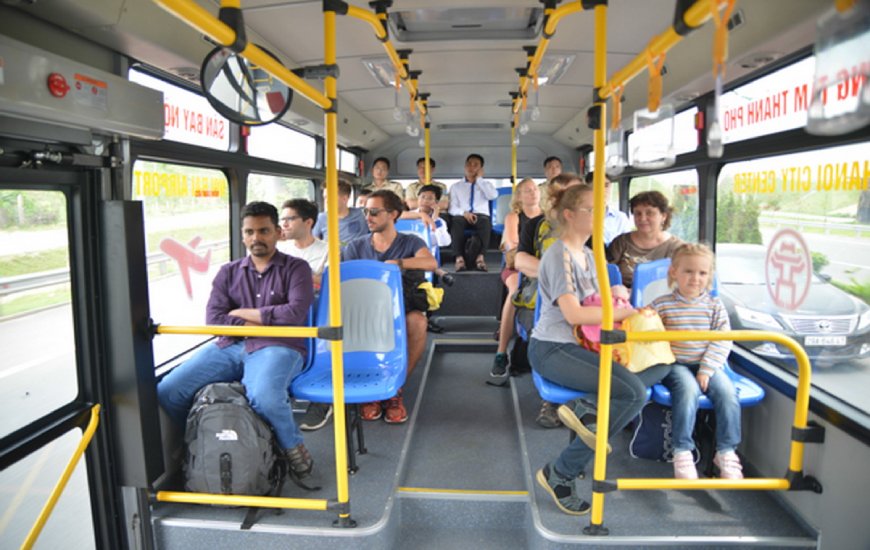
Right after you get on a bus, find a seat before the bus moves because Hanoi bus drivers are known for their quick braking and brief stops. You cannot buy tickets online in advance because paper tickets are issued upon arrival and must be paid for in cash by the staff, who will hand them over to passengers. You can give the money directly to the rickshaw drivers, and receive a ticket from them. Note that they only accept Vietnamese Dong so that is advised that you bring cash (small bills are recommended) with you. Bus drivers in Vietnam are often in a hurry, causing them to stop buses quickly. To avoid missing the bus, it is essential to prepare and wait at the bus stop 5-10 minutes earlier. Remember to leave your seat and stand at the back door when the bus gets close to your destination to get off the bus at the right time.
How much is a bus ticket in Hanoi?
The bus ticket price in Hanoi City Bus ranges from 7,000 to 15,000 VND, with each bus having a red number centered in a white circle and visible in the front sign, depending on the distance between the departure and endpoint.
What is the cheapest way to get around Hanoi?
Bus travel is a popular and affordable mode of transportation in Hanoi, with services available from major cities. Long-distance coaches offer a comfortable and affordable way to travel from Hanoi to other parts of Vietnam.
Are there pickpockets on the bus in Hanoi?
Hanoi's public buses can be crowded, sometimes with pickpockets present. Ensure to cover your purse, wallet, and valuable items, or place the backpack in front of you.
Can I buy a bus ticket online?
You cannot buy tickets online in advance because paper tickets are issued upon arrival and must be paid for in cash by the staff, who will hand them over to passengers. Note that they only accept Vietnamese Dong.
What is the operation time of Hanoi buses?
The earliest bus leaves at 4:30 a.m., while the latest leaves at 10:30 p.m. Service may be extended to 11:30 p.m. on weekends on some routes.


