
Private tailor-made journeys of a life time

(+84) 942777545
sales@vietnamescapetours.com
Need Help?
Private tailor-made journeys of a life time
Sep 29, 2023
By Ms. Anh Thu
Overview
When traveling to Hue, visitors will experience the most complete preservation of the soul and the beauty of ancient Vietnam. In particular, Thien Mu Pagoda Hue Vietnam is dubbed by the locals the "soul" of this land. Thien Mu Pagoda is a check-in destination to be noticed when visiting Hue Ancient Capital. Thien Mu Pagoda, the center of power of the last feudal Nguyen dynasty in Vietnam and the previous capital, is notable for its stunning scenery and architecture as well as its historical significance. Let’s discover the fascinating and exciting things in this 400-year-old sacred temple with us!
Hue is a charming city and you can add it to your top list of destination for your trip in Vietnam and Thien Mu Pagoda is a must for your tour in Hue.
The pagoda's name comes from a legend about an old woman appearing on the hill, informing the locals that a Lord would build a Buddhist pagoda for the country's prosperity. Lord Nguyen Hoang ordered the construction of the "Heaven Fairy Lady" or Thiên Mụ in Vietnamese. The mysterious history has attracted tourists from both inside and outside the nation to explore the legend.
The name "Thien Mu" is also said to be taken from an ancient verse: "Thiên Mụ tự biến cố triều" (Thien Mu Pagoda is located on the border of the ancient imperial palace). In both ways, Thien Mu means Heaven Fairy Lady or lady coming from Heaven, and Thien Mu Pagoda is also called Linh Mu Pagoda. Thien Mu Pagoda has undergone many stages of remodeling and development but still retains the ancient and majesty characteristics of a spiritual temple.

The old-aged Thien Mu Pagoda was built at the beginning of the 17th century by Lord Nguyen Hoang, becoming one of the earliest sacred pagodas in Hue. Thien Mu Pagoda has a history of more than 400 years and is considered a cultural and religious symbol of the dreamy Hue city.
Under the Nguyen lords, Thien Mu Pagoda has undergone many major renovations, of which the most prominent is the restoration under Lord Nguyen Phuc Chu (1691-1725). In addition, Nguyen Phuc Chu also cast a large bell weighing more than two tons in 1710 and engraved the bell with an inscription. In 1714, he continued to greatly restore other works in the temple such as Thien Vuong Palace, Dai Hung Palace, Lecture House, and Tang Kinh floor... In particular, Lord Nguyen Phuc Chu also sent people to China to buy more than 1,000 sets of Buddhist scriptures with the purpose of praising Buddhist philosophy are located on the Tang Kinh floor, in addition, the scriptures also clearly record the story of Venerable Thach Liem, who had great merit in helping Lord Nguyen revive Buddhism in Vietnam.
The significance of Thien Mu Pagoda Hue Vietnam
Thien Mu Pagoda, located on the Perfume River, is a historical landmark that holds significant cultural significance for the Hue people in particular and the Vietnamese people in general. Despite its limited Buddha statues, the temple is a holy site for the people, with its garden resembling a palace for ancient Hue kings and mandarins. Visiting this sacred space offers a serene and dreaming experience, allowing visitors to escape the stresses and worries of daily life.
Thien Mu Pagoda, a historical landmark in South Vietnam, played a significant role in anti-government protests during the summer of 1963. The Buddhist majority in South Vietnam was dissatisfied with President Ngo Dinh Diem's rule, which showed favoritism towards Catholics and discrimination against Buddhists in the army, public service, and government aid distribution. This led to mass protests in Hue, where nine Buddhists died in 1963. The pagoda was a major organizing point for the Buddhist movement and was often the site of hunger strikes, barricades, and protests. Today, the pagoda is surrounded by flowers and ornamental plants, and a serene pine-tree forest is located at the far end of the garden. The well-maintained pagoda is a welcoming destination for visitors.
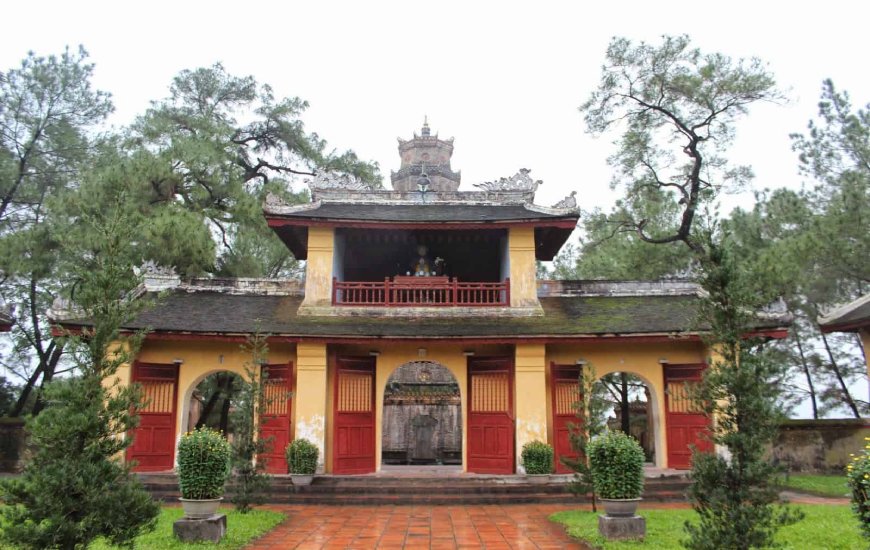
The Tam Quan Gate of Thien Mu Pagoda is considered one of the most surprising architectural wonders of the pagoda. The gate consists of three floors and looks like an ancient tower from afar. The lowest floor is an equilateral triangle, the middle layer is circular, and the top floor is square. Each floor is decorated with unique textures and delicate colors. The Tam Quan Gate symbolizes the unity between Heaven, Earth, and Man in Buddhist philosophy.
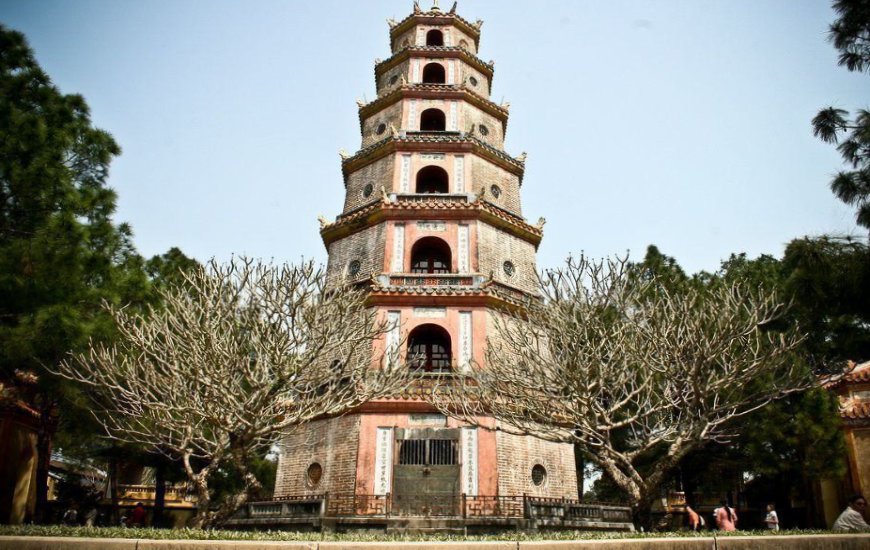
Phuoc Duyen Tower is a must-see check-in point at Thien Mu Pagoda in Hue, built in 1844 by King Thieu Tri. It is located right after the welcome gate area and is likened to the "soul" of the pagoda. The tower, built from rustic bricks and bar stone, forms an octagonal block with 7 floors, each 2 meters high. Each floor is painted pink, showcasing the unique value of Hue's ancient capital's architecture. The tower is 21 meters high and consists of 7 floors, each with a statue of Buddha on each floor. Inside the tower, a spiral staircase leads to the top floor, where the golden Buddha image was previously worshiped. The tower's unique features and bold architecture make it an impressive point for tourists visiting Thien Mu Pagoda.
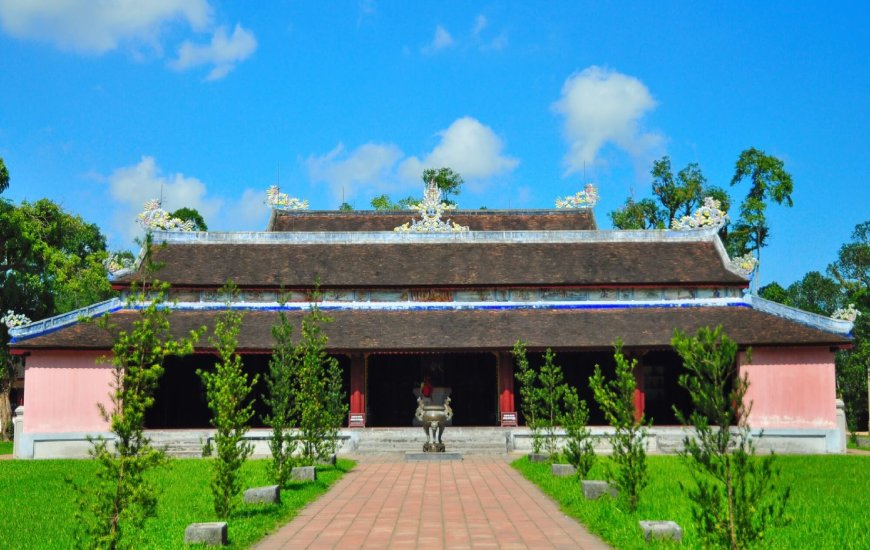
Dai Hung Palace is the main hall of Thien Mu Pagoda, where Maitreya Buddha worship is located. The Buddha has large ears, a belly to tolerate mistakes, and a mouth to maintain peace. The palace features a picture with the words "Linh Thuu Cao Phong" engraved on it, as well as a large bronze bell carved in the shape of a moon and moon. The shrine of Tam The Buddha is visible on the left and right, with Manjushri Bodhisattva and Universal Worthy Bodhisattva on the left and right. The palace also features a car display of the late monk Thich Quang Duc, who burned his body to fight the repressive Buddhist regime, and the tomb of the late monk Thich Don Hau, who contributed to the revival of Buddhism.
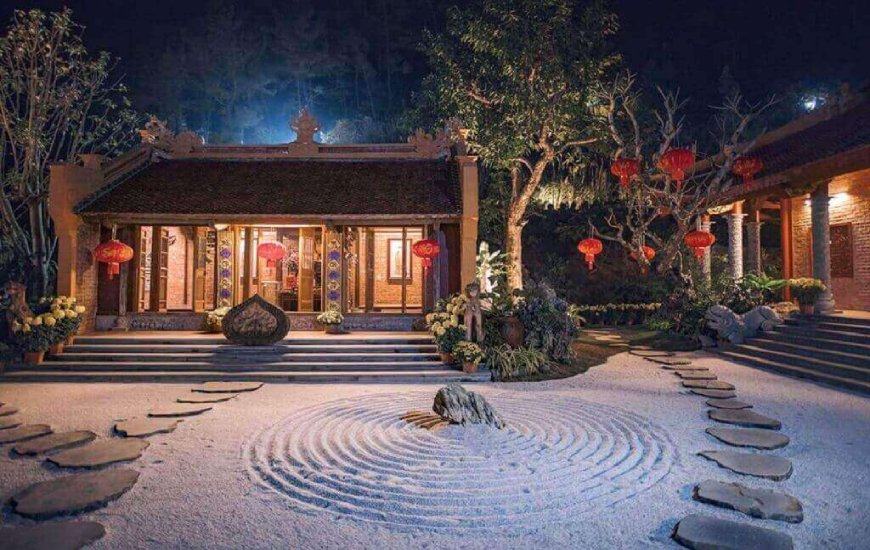
This work is located right behind Dai Hung Palace. The scenery here provides you with a feeling of peace and tranquility. With a large yard in front, with grass and a green lake. Surely this will be an interesting stop in your trip to explore Thien Mu Pagoda in Hue that you cannot ignore. The Temple of Earth has a subtle, winding feature with carved patterns, built on the Maitreya foundation.
Huong Nguyen communal house is located right in front of Phuoc Duyen Tower. Huong Nguyen communal house is a flashy, massive, and unique building. Unfortunately in 1904, a storm hit and devastated the house, causing heavy damage. Later, the communal house was restored for tourists to visit. In particular, in the event, the late monk Thich Quang Duc drove and burned himself. Hong protested against the policy of suppressing Buddhism by Ngo Dinh Diem's government on June 11, 1963. Currently, his Austin car that day is on display at Dai Hung Palace.
Quan The Am temple humbly hides in the nature of flowers and leaves, simple in a rustic way, without carved patterns. This is the shrine located at the end of the temple; located in the middle of the forest and decorated quite simply, without patterns but evokes a special atmosphere. In the main hall there is a statue of Bodhisattva Avalokitesvara, cast in black bronze; with a gentle face and sitting on a lotus platform, above is a picture of Quan Am Dien. In front of the Avalokitesvara bronze statue, there is also a stone statue lying in a glass cabinet, with long slender fingers, and soft and flexible lines.
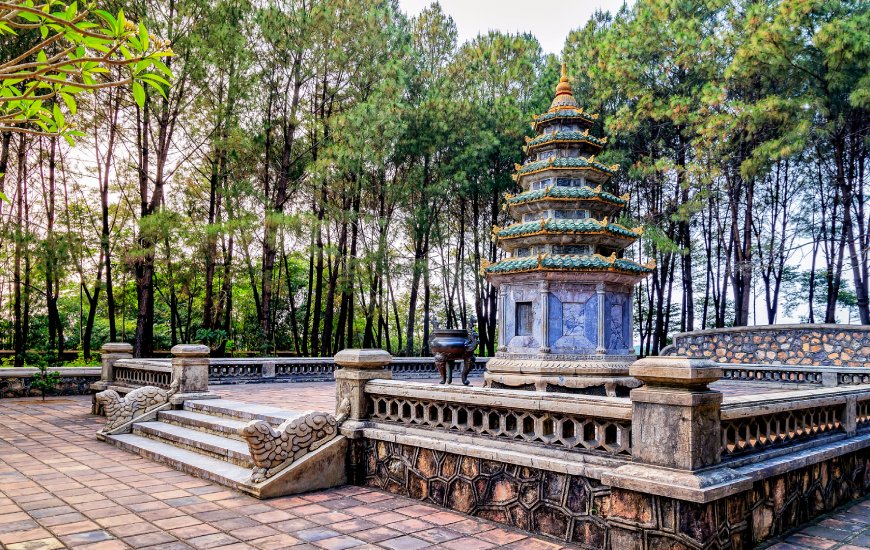
Most Venerable Thich Don Hau is the famous abbot of Thien Mu Pagoda in Hue. He dedicated his life to advancing Buddhism in Vietnam. In addition, he engaged in a great deal of public service and helped his community, earning him the esteem of the populace. The Venerable was buried by people and temple administrators under a tower at the end of the campus after his passing. This was a way they showed gratitude to the revered monk.
Thien Mu Pagoda in Hue is covered with delicate pine trees, ornamental plants, and lotus ponds. The sweet scent of lotus spreads everywhere. Leaving behind all the noise and fatigue outside, here, visitors only hear the sound of slow footsteps, the gentle sound of falling leaves, and sometimes a clear bell, humming, echoing, or the sound of wood. emanating from the muzzle in the main hall... all create a majestic but dense Buddhist space. The poetic and pure scenery of this place makes visitors stop to admire the scenery and want to stay forever.
A well-known historic pagoda called Thien Mu Heavenly Lady Pagoda (Linh Mu Pagoda) is situated on the hill of Ha Khe, on the left bank of the poetic Perfume River, about 5 km west of Hue City, Vietnam, which can be easy to reach from the city center. The picturesque scenery around the Thien Mu Pagoda served as the basis for several pieces of poetry and music. The historical, cultural, spiritual, and artistic significance of the temple all contribute to its aesthetic splendor. The Thien Mu Pagoda was listed as one of Hue's best attractions to see.
Thien Mu Pagoda is best visited during two prime periods: January to February and May to June. January offers beautiful weather with low temperatures and light rain, while May to June offers stunning red phoenix flower blossoms.
Thien Mu Pagoda is conveniently located just 5km from Hue city center, making it accessible via various transport options. Motorbike rental is available for 100.000-150,000 VND per day, while a dragon boat takes about 30 minutes to reach the pagoda. Cycling is a great way to explore the area, but it's best to cycle early in the morning to avoid the noonday sun and heavy traffic. Cyclo Tours offers peaceful scenery and an introduction to Hue, with prices varying from 40,000 to 100,000 VND per trip. Taxis are the most convenient option, with options including traditional taxis or environmentally friendly XANH SM Taxi.
How much does it cost to go to Thien Mu Pagoda? Thien Mu Pagoda Hue, Vietnam is a Buddhist temple with no entrance fee, making it free to explore. To park near the pagoda, visitors pay VND 5,000 for bikes and VND 10,000 for scooters.
Opening hours: Thien Mu Pagoda in Hue Vietnam offers flexible opening hours from 6 am to 8 am. To avoid crowds and capture beautiful photos, visit between 6 am and 8 am. For sunset views on the Perfume River, visit at 6 pm.
Hue's attractions, like Thien Mu Pagoda and royal tombs, can be reached by boat via the Perfume River. Shared day tours are available for hotels and travelers' cafes.
Wear neat, clean, and polite clothes when visiting the temple. Avoid flashy, colorful, or revealing attire, as it violates precepts, disrespects, and dissipates merits. Children are prohibited from running around, playing with sacrifices, or touching Buddha statues.


