
Private tailor-made journeys of a life time

(+84) 942777545
sales@vietnamescapetours.com
Need Help?
Private tailor-made journeys of a life time
Aug 1, 2023
By Ms. Anh Thu
Independence Palace Ho Chi Minh City is one of the most unique and famous architectural works in Ho Chi Minh City, which has existed for more than 150 years. The work not only reflects aesthetic values but also embodies tremendous historic values. Being one of the most worthy destinations in Saigon, you cannot miss Reunification Palace for your Day Tour from Ho Chi Minh.
Independence Palace, also known as the Reunification Convention Hall (Hội Trường Thống Nhất in Vietnamese) or Reunification Palace is a landmark in Ho Chi Minh City (formerly known as Saigon). Reunification Palace is the English name of Dinh Doc Lap. This is the place witnessing many important milestones in the history of the nation's struggle for independence, representing the enduring vitality and fighting spirit of the previous generations.
The Reunification Palace, originally named Norodom Palace, was built in 1868 as a residence for the Governor of Cochinchina in Ho Chi Minh City. It served as a residence for French governors during the Indochina invasion. By 1945, the Japanese monopolized Indochina, and the Palace became the Japanese government's workplace. After the French colonialists' failure in the Dien Bien Phu campaign, they signed the Geneva Agreement before withdrawing their army from Vietnam. In 1954, Prime Minister Ngo Dinh Diem changed the Palace's name to Independence Palace. However, Ngo Dinh Diem's family-ruled dictatorship caused resentment and discontent within the Saigon government. The Palace was destroyed by protesters, forcing Ngo Dinh Diem to rebuild it. The South Vietnam National Liberation Front banner was flying over the palace's roof at about 11:30 on April 30, 1975. Former Liberation Radio employee Nguyen Huu Chau said that he was really pleased to discover that our men had raised the National Liberation Front of South Vietnam flag on the roof of the palace. We all need to keep in mind that occasion and the enormous sacrifices made by the Vietnamese people.

Reunification Palace in 30/04/1975
Independence Palace is the place to witness the victory results of the Vietnam People's Army. The deepest and most glorious in the history of national liberation and reunification on April 30. It is the greatest achievement in the cause of national liberation and national reunification led by our Party and President Ho Chi Minh, ending 30 years of war for independence, and bringing our country into a period of independence and freedom. the Independence Palace is the place that marked the day when the South was completely liberated and reunified, a historical image.
Today, it is the venue for important meetings. Besides, it is the place to welcome heads of state when coming to Ho Chi Minh City. It is also a tourist attraction that attracts both domestic and foreign tourists. In 2009, this was one of the first 10 National Monuments of Vietnam recognized. Having existed for more than a hundred years in the middle of Saigon, witnessing many changes in history. Experiencing the ups and downs of history, the Independence Palace is not just a "witness" to history. It is also a symbol of harmony and unification of the country. This is a typical architectural museum, the pride of Vietnamese people.
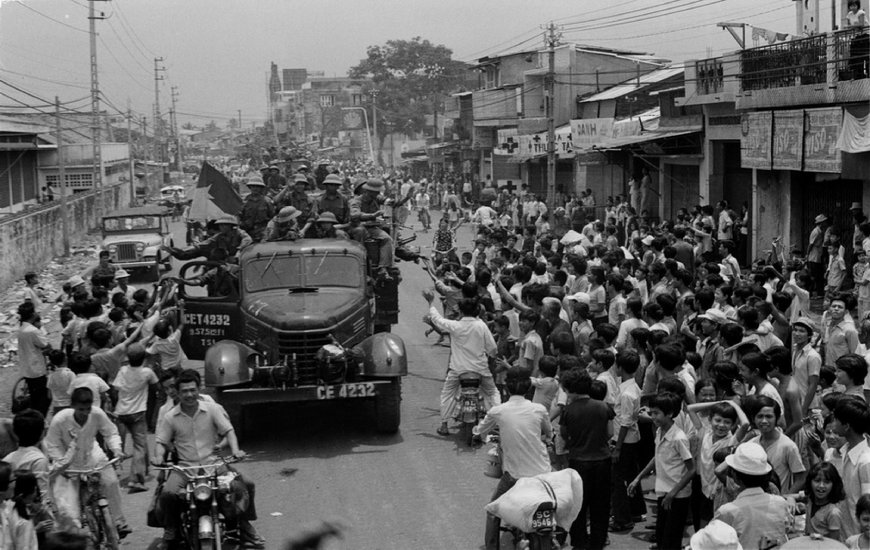
Vietnamese people's happiness in national liberation and national reunification day
Reunification is located at 135 Nam Kỳ Khởi Nghĩa, P. Bến Thành, Ho Chi Minh City, right at one end of Le Duan Street. Or you can search for the Reunification Palace is located in District 1, the center of Ho Chi Minh City, near popular tourist attractions like Notre Dame Cathedral, 30/4 Park, and Central Post Office. Its front gate faces the intersection between Le Duan Street and Nam Ky Khoi Nghia Street.
The Independence Palace design combines modern architectural art with traditional oriental architecture, showcasing the country's philosophy, Eastern rituals, and personality. The stone flower curtain, shaped like bamboo burning, adds to the Palace's beauty and absorbs sunlight. The palace's architectural lines are straight, with corridors, halls, and rooms incorporating the main sentence of Dai Quang Minh. The front yard features an oval lawn with a 102m diameter, creating a soothing atmosphere for guests. A semicircular lake runs across the hall, evoked by lotus and water lilies, resembling peaceful lakes in ancient temples and pagodas. In the left corner of the Palace, an octagonal house with a 4m diameter, built on a high mound, is located on Nguyen Thi Minh Khai Street, providing a relaxing space for visitors.

An inside look of the Independence Palace
Artifacts exhibited at Reunification Palace
Reunification Palace's historical treasures serve as a testament to Vietnam's valiant past. The items are kept in great condition and well-preserved for viewing by guests.
President Nguyen Van Thieu's UH-1 helicopter is on display on the roof of Reunification Palace, just next to where two bombs that its pilot Nguyen Thanh Trung fired detonated.
German-made Mercedes: The Mercedes Benz 200 W110 with the license plate VN-13-78 is a German vehicle. One of President Nguyen Van Thieu of Vietnam's automobiles was this one.
The Jeep: The Revolutionary Forces utilized the Jeep M152A2. The automobile is unique because it was used to transport Mr. Duong Van Minh, the final President of the Vietnam dictatorship, to the Saigon radio station on April 30, 1975, where he read the statement of capitulation.
Modern vehicles like the E 390 and 843 tanks as well as F5E jets were also employed during the Vietnam War. All of these antiques help Thong Nhat Palace stand out to travelers as a more desirable travel destination.
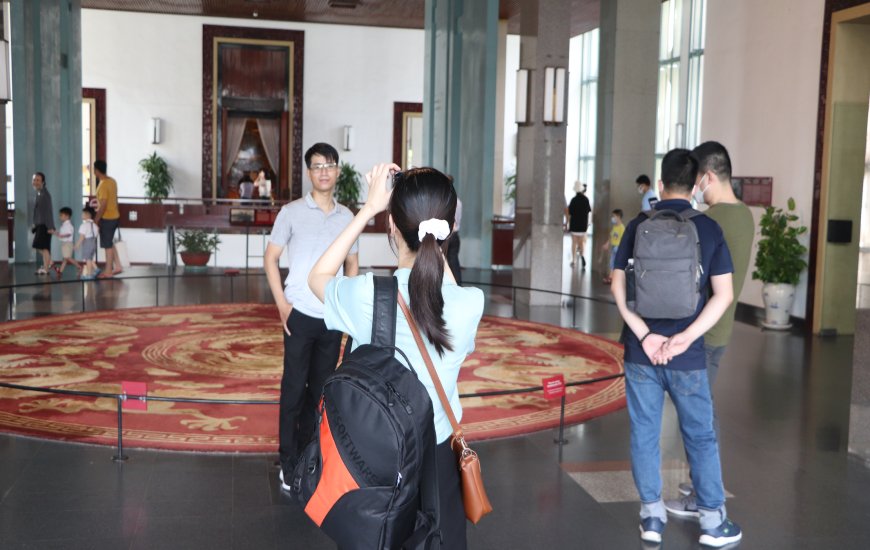
Tourists taking photos with artifacts exhibited at Reunification Palace
Visual Arts
The Reunification Palace not only showcases historical objects but also several priceless works of art.
The oil paintings include one by architect Ngo Viet Thu that features a rural Vietnamese scene. Another oil painting depicts the sisters Thuy Kieu and Thuy Van meeting Kim Trong for the first time on the day of Ancestors Day, also referred to as the Festival of Tending Graves.
Numerous old Chinese ceramic pots from the Ming and Qing dynasties may be found at the Reunification Palace.
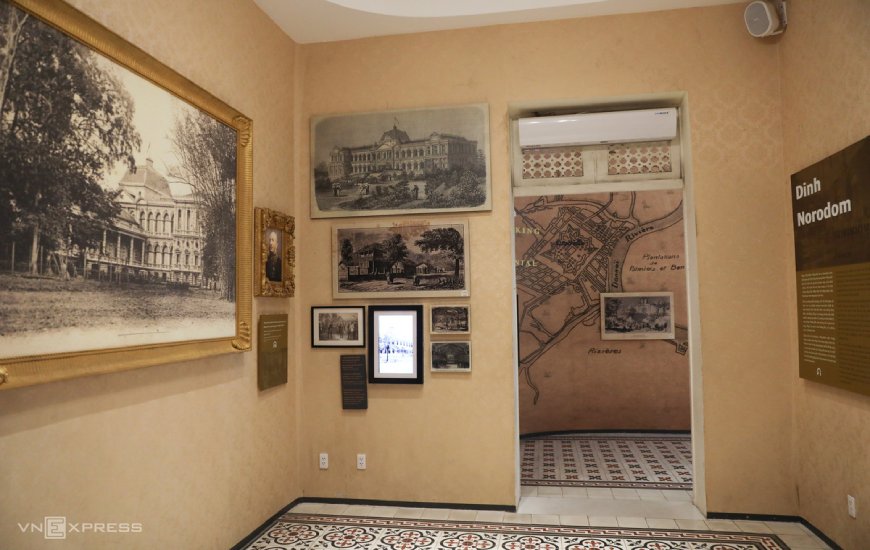
Visual Arts
If traveling by motorbikes, buses, or on foot, ask locals for directions. If staying at a hotel in District 1, it takes 15 to 20 minutes to walk to the Reunification Palace. If not, taxi drivers can take visitors to the Independence Palace. The building is easily recognizable on Saigon streets. Bus numbers for those traveling by bus include 001, Ben Thanh Cho Lon Bus Station, 002, Ben Thanh Western Bus Station, 03, Ben Thanh Thanh Loc, 04, Ben Thanh Cong Hoa Ben Xe An Suong, and 05.
Independence Palace is a historical site that welcomes tourists every day of the week, including holidays and New Year's Eve. So, any season of the year is appropriate to visit the Palace. But because it will be busier than normal on holidays like New Year's Eve and Independent Day (September 2), tourists should think about going to the Palace on those days. It is also busy on the 30th of April Reunification Day (Ngày Thống nhất) also known as Liberation Day (Ngày Giải phóng)
Visitors must rigorously abide by the following basic guidelines for the administration of the monument when visiting the Reunification Palace since it is a revered location bearing witness to the valiant history of Vietnam:
Dress formally and stay away from shorts and skirts.
During the visit, heed the guard's instructions and the signage.
Bring no bags to the monument.
Food and beverages are not permitted within the monument.
Animals are not permitted within the monument.
Bring no explosives, weapons, or hazardous materials into the monument.
Be accountable if you damage the monument in any way.
Reunification Palace Ho Chi Minh City is one of the best places to visit in Saigon. Having witnessed Vietnam with many hardships and challenges, the Independence Palace is recognized as a national cultural and historical relic with historical significance and the fighting spirit of our nation. Hope you will have a great time visiting this historic site. Thank you for reading.


