
Private tailor-made journeys of a life time

(+84) 942777545
sales@vietnamescapetours.com
Need Help?
Private tailor-made journeys of a life time
Sep 22, 2023
By Ms. Minh Thu
Have you ever heard of floating markets? This is an extremely unique and distinctive cultural feature of many Southeast Asian countries as well as Vietnam. Floating markets in Vietnam, however, still have their own unique features. Which means do they sell by, what are the main products, how do they advertise in floating markets in Vietnam? All will be answered in the article below by the best Vietnam tour operator.
No one can tell exactly when and how floating markets in Vietnam are formed. However, according to MA. Tran at Vietnam National Institute of Culture and Arts in Ho Chi Minh City, floating markets are manifestations of how locals have adapted to the natural environment. It is clear that the Southern part of Vietnam is full of rivers; in other words, the density of rivers in the area is very high. In the condition that roads didn’t develop, people made use of their custom of trading on rivers, floating markets gradually formed.
Trading is conducted above the water
As its name suggests, goods exchanging activities are implemented on rivers. It is downright unique and impressive because common markets are the crowded spots on land where people gather and exchange products. However, adapting to the natural terrains, these floating markets really come into their own in meeting the needs of trading. All activities are done on boats, which are normally the transportation means on rivers, now become the critical facilities in this trading form.

Trading is performed flexibly
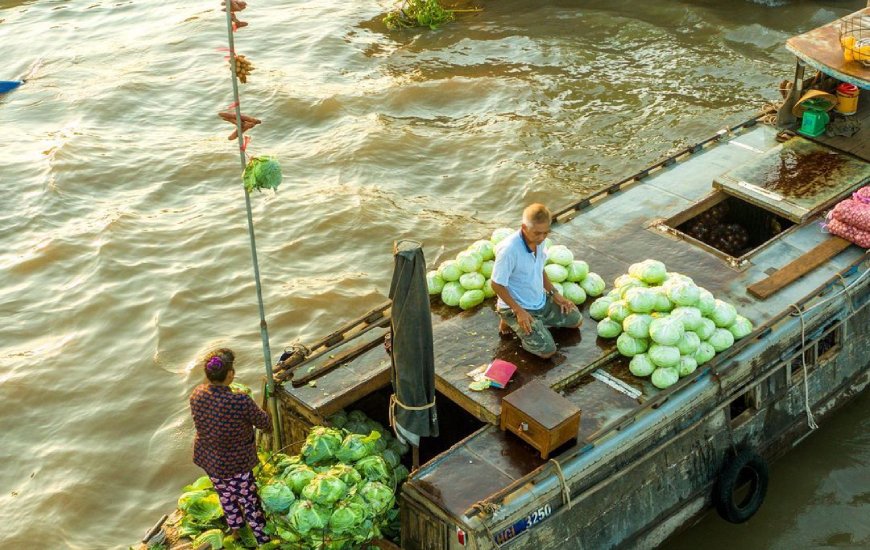
When it comes to floating markets in Vietnam, we all know that exchanging goods on rivers is done floating on rivers. However, the bottom line is, these spots selling goods are not fixed, they are flexible. While in other common markets, shops or stalls are fixed regarding position, waiting for buyers to come and purchase goods;”shops” in floating markets are movable because they are literally boats. Goods such as fruits or flowers are fully loaded on boats, they are then moved to anywhere on the river. Hence, sellers on floating markets need to be better at peddling when introducing their goods to the buyers. The Beo tree, used to attract the seller’s attention, is considered the soul of the floating market, usually a pole made of bamboo, used to hang on the top of the pole fruits and vegetables that are displayed for sale on the boats so that buyers can have them from afar. recognizable. Beo tree therefore became a convention and creativity in advertising and marketing very early in the Mekong Delta. This is a unique way of advertising, not noisy, busy, not holding back but has the power to attract customers, and is a feature of the "merchant business culture" of the floating market.
Floating markets are cosmopolitan
Normally, floating markets in Vietnam are the points where river branches meet. Hence, sellers here are from many provinces and areas. The goods sold on boats consequently are various, including specialties of many different places. This creates a colorful picture and uniqueness for this type of trading. So floating markets are not only the destination to exchange goods, but also exchange cultures.
Garden fruits are the main goods of floating markets
This reflects an important trait of Southern agriculture, which is that the main agricultural product is fruits. Being substantiated by illuvium from rivers, as well as often provided with plentiful water, soil in this area is especially fertile. Adding to this, the climate is favorable to growing fruits, so many breeds thrive in this area. Besides wet rice, garden fruits is the key product of agriculture and critical goods in floating markets in Vietnam.

1. Cai Rang Floating Market
Cai Rang floating market is located in Cai Rang district, Can Tho city, 0 minutes by boat from Ninh Kieu wharf. This market has existed for more than a century and is a symbolic image of Mekong Delta culture as well as the first name when it comes to Floating Markets in Vietnam. Cai Rang Floating Market was born to meet the trading needs of people when roads were not yet developed. Nowadays, although road facilities have been very developed, Cai Rang Floating Market still operates as a beautiful mark of history. The most suitable time to visit the market is from 5 to 8 am, when hundreds of boats and boats come here from all directions. Beo sticks are a familiar sight in floating markets. Whatever the boat sells, it hangs on it. For example, a boat selling cabbage hangs a cabbage plant on the highest end of the bamboo stick. That way, buyers can easily recognize it. Then people exchange it with each other by tossing or passing it around. These mobile shops have contributed to turning Cai Rang floating market into one of the 10 most impressive markets in the world, describing a particularly unique feature as the "brilliant tropical colorful" sales boats. Experiencing the rich culture here, in addition to enjoying fresh garden fruits right on the boats, you can try other specialties of Southern cuisine such as Pho, snacks, noodles, and coffee. In 2013, worldwide renowned masterchef Gordon Ramsay used to try Vietnamese cuisine. Accidentally floating on the Cai Rang floating market, the noodle soup left an unforgettable impression on him.

2. Cai Be Floating Market
Formed a long time ago, Cai Be Floating Market (Cai Be town) is one of the floating markets with unique cultural features of the Southwest region. The birth and development of floating markets has affirmed the dynamic and creative spirit of river residents. With unique living features, Cai Be Floating Market is one of the attractive tourist destinations of Tien Giang in particular and the Southwest in general. Not just being one of the largest floating markets in Vietnam, Cai Be floating market is on top of the region of South East Asia. The Southwest floating market in general and Cai Be in particular have been formed since the footsteps of Vietnamese immigrants to explore this land from the 17th - 18th centuries. With unique living features, Cai Be Floating Market is one of the attractive Tien Giang tourist destinations visited by a large number of domestic and international tourists. At one time, the number of visitors to this place accounted for about 80% of the total number of tourists traveling to Cai Be district. And this is also a tourist destination that is heavily exploited by travel companies. Almost every travel itinerary to the West has at least one or two schedules to explore Cai Be Floating Market.

3. Long Xuyen Floating Market
This is also a famous floating market in Vietnam. Located on the Hau River area, near Long Xuyen City Center, Long Xuyen floating market has become a tourist destination not to be missed every time visitors come to An Giang. Long Xuyen floating market was formed a long time ago. Although traffic is convenient and developed, the floating market still exists and maintains its original form of living to this day. This is one of the presentative images of An Giang people as well as people living around the Mekong River. The starting point of the floating market is from the O Moi ferry, running along the Hau River for about 2km, located in My Phuoc ward. Motor boats promise to take visitors to every corner of the floating market. 5 am is the optimum point of time to drop by Long Xuyen Floating Market. The cold beginning of morning dew will not deter those who love and discover new things. In particular, visitors can watch the sunrise on the river, far away on the horizon are streaks of pink and white clouds interwoven, blending together in the sky, all adding to the aftertaste of the lives of these people. Working people are floating on the river every day.

4. Nga Bay Floating Market
Being famous for busy and lively trading activities, Nga Bay market is one of the most famous floating markets in Vietnam. Hidden deep in the floating market is the depth of indigenous culture not only of Hau Giang but the soul of the entire Mekong river region. The soul of the river is the floating market because it traces the footsteps of ancestors, connecting the past with the present; habits, customs, spirituality and the creation of the commercial and economic culture of our ancestors for more than a century in the new land. Today, Nga Bay floating market is one of the most famous floating markets in Vietnam, also appearing on most tourist websites and travel guidebooks at home and abroad. If you want to visit the Nga Bay floating market, you can rent a shell. At the ferry wharf, many small boats carry 3-4 passengers to the floating market. The boat left the wharf, the beautiful floating market landscape appeared in the morning mist. The daily life of Nga Bay people is very lively and interesting. Hundreds of boats and ships, large and small, parked close together. Nga Bay floating market is a wholesale market specializing in wholesale buying and selling of local fruits and agricultural products. Goods are concentrated here in large quantities. Each item has been classified for uniformity in quality, size and packed into cartons. If local people and surrounding areas often use boats and canoes to transport agricultural products here for consumption, the boats with large tonnage are used by traders to buy fruits and spread them everywhere.

5. Nga Nam Floating Market
Coming to Nga Nam market at the right market time, visitors will see the entire market as a vivid, colorful painting. Colors from vegetables and fruits; the color of grandmother's dresses fluttering in the wind; Big and small boats, five- and three-leaf canoes bustling up and down; The sound disturbed the entire river area. If in other markets, the market usually opens at dawn and is bustling from morning to noon, then Nga Nam floating market is more special because the market opens at a time when the sky and earth are still dim, at 3-4 am. By the time the sun rises, at 7-8 am the market is almost over. At this time, only boats loaded with goods to transport to neighboring areas are still operating. Although today, trading activities are getting busier and more tourists come here, Nga Nam floating market still retains a rustic look in both the way of trading, down to the invitation of the seller row.

The attractiveness of these floating markets in Vietnam perhaps comes from the simpleness and rurality; hence, these places are worth visiting on your trip to Vietnam. It is not a bad idea to merge into river culture after you explore a historic destination in Saigon. This will be a good trip for you and your beloved ones.


